One-stop Bending Solutions For Wires, Tubes And Pipes
One-stop Bending Solutions For Wires, Tubes And Pipes
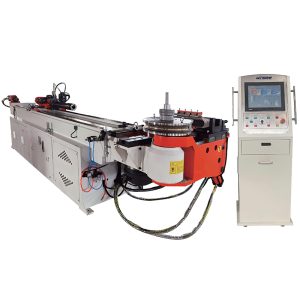
I. Core Structure of the Automatic Pipe Bending Machine
The automatic pipe bending machine is composed of five core modules working in conjunction: support base, positioning and adjustment, drive and execution, clamping and fixing, and CNC control, to precisely achieve automated pipe bending operations:
Support Base: Uses a high-strength cast iron integrated base, paired with anti-vibration pads and leveling bolts, which effectively disperses the circumferential force and resistance torque during pipe bending, preventing machine body deformation, and provides a stable installation base to ensure stable equipment operation;
Positioning and Adjustment System: Includes a central slide, a small slide, and a large slide. The central slide is driven by a hydraulic motor, and the clamp center is precisely positioned with a scale; the small slide is driven by a gear and rack mechanism, locked by a positioning pin and tightened by a set screw; the large slide uses a servo motor + ball screw drive to ensure that the clamp and guide wheel centers are coaxial, with an overall positioning error of ≤0.01mm;
Drive and Execution Mechanism: The main drive uses a servo motor paired with a gearbox to provide continuous and stable torque for pipe bending; the swing arm is made of alloy steel and welded, capable of withstanding the circumferential force and resistance torque during processing; the return hydraulic motor and electromagnetic clutch work together to drive the swing arm to return smoothly at a speed of 2.2 r/min;
Clamping and Fixing Device: Wear-resistant rubber groove plates are used to support the pipe blank, preventing surface scratches; the clamping cylinder drives the punch downwards to clamp the pipe, and the large slide clamping cylinder simultaneously locks the workbench, providing double fixation to prevent pipe blank sliding and deformation;
CNC Control System: Equipped with a PLC + touch screen operation interface, it supports parametric input and program storage of bending radius, angle, and other parameters. It uses closed-loop control to adjust the actions of each component in real time, and also has practical functions such as fault alarm and processing counting.
II. Core Working Principle of the Automatic Pipe Bending Machine
The machine follows an automated cycle process of “material feeding and positioning → clamping and fixing → pipe bending → swing arm return”:
After the pipe blank is placed flat on the grooved plate, the CNC system drives the slide table assembly to move sequentially, completing the precise positioning of the chuck and the swing arm’s rotation center;
The pressing cylinder and the large slide table clamping cylinder are activated in sequence, double-locking the pipe blank and the workbench to ensure processing stability;
The main drive rotates the swing arm, causing the pipe blank to undergo plastic deformation along the preset bending radius. The servo motor adjusts the rotation speed in real time to adapt to different pipe materials;
After the pipe bending is completed, the cylinder releases pressure, the electromagnetic clutch closes, and the return motor drives the swing arm back to its initial position. The equipment enters standby mode, waiting for the next operation.
III. Core Advantages of Automatic Pipe Bending Machines
High Precision: Bending radius error ≤ 0.01mm, angle error ≤ 0.1°, meeting the needs of precision machining;
Fully Automatic: From parameter input to processing completion, the entire process requires no manual intervention, ensuring convenient and efficient operation;
High Efficiency and Stability: Servo + hydraulic composite drive, fast response, enabling 24-hour continuous and stable operation;
Strong Versatility: Adaptable to various pipe materials such as steel, copper, and aluminum pipes with diameters of 5-50mm and wall thicknesses of 0.5-5mm, offering a wide range of applications.
We have many web servers with different models and features. If you have any needs, please feel in touch for a consultation, and our professional sales staff will assist you.
Our equipment has CE, ISO quality inspection certificate, so the quality is guaranteed to be cost-effective. According to different processing requirements, machines can be customized to fit for your usage, to provide customized services. In the processing period, we strictly control the production process, to ensure the quality of clearance, standardize the process, strict implementation.

