One-stop Bending Solutions For Wires, Tubes And Pipes
One-stop Bending Solutions For Wires, Tubes And Pipes
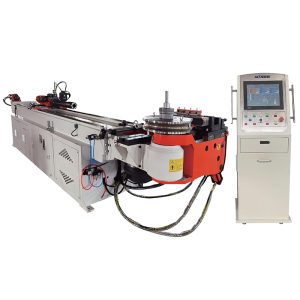
I. Principles of Automatic Pipe Bending Machine Processing and the Role of the Mandrel
Automatic pipe bending machines utilize a combination of mechanical, hydraulic, and electrical systems to drive the bending die, causing plastic deformation of the pipe. They are widely used in industries such as automotive and aerospace. The mandrel is a critical component for ensuring bending quality. It extends into the pipe to support the inner wall of the bending radius, preventing inner wall collapse, wrinkling, and cross-sectional distortion. Especially in small pipe bending machines processing thin-walled pipes with small diameters, the mandrel directly determines the finished product’s pass rate. Without mandrel assistance, the pipe is prone to wrinkling and cracking, making it difficult to achieve the required accuracy.
II. Types of Mandrels for Automatic Pipe Bending Machines
Mandrels must be selected according to the equipment model, pipe parameters (material, diameter, wall thickness), and process requirements:
Column Mandrel: Simple structure and high rigidity, suitable for pipes with wall thickness ≥2mm and bending radius ≥3 times the pipe diameter. It has good compatibility with the pipe bending machine’s clamping system and offers high efficiency for mass production. Not suitable for thin-walled pipes with small diameters.
Universal Ball Head Mandrel: Available in single/double/triple/quadruple ball head configurations, it rotates flexibly along the bending trajectory. Suitable for small pipe bending machines processing thin-walled pipes, small radius bends (≤2 times the pipe diameter), or multi-angle bending. Multi-ball head versions provide more stable support, reducing errors caused by insufficient equipment rigidity.
Directional Ball Head Mandrel: Strong directionality, suitable for mass production with fixed trajectories. It has high compatibility with the pipe bending machine’s control system, balancing rigidity and flexibility, and is suitable for high-precision processing with stable processes.
III. Mandrel Adjustment and Equipment Linkage Operation
Theoretical Datum: The tangent of the mandrel’s front end should be aligned with the tangent of the bending die. This is positioned using the bending machine’s adjustment knob and aligned with the mechanical origin.
Optimal Position: In actual operation, the mandrel should extend 1-2mm beyond the tangent of the bending die. This is achieved through manual fine-tuning and calibration. After trial bending, gradually adjust until there are no wrinkles on the inner wall and no dents on the outer wall.
Deviation Correction:
If the lead amount exceeds 2mm: The outer wall of the pipe will show a “goose head” deformation. The mandrel lead amount needs to be reduced, and the pressure of the pressing die needs to be increased simultaneously. Position lag: Tube wrinkling, excessive springback (angle decreases or radius increases). The mandrel needs to be advanced towards the tangent point, and the springback compensation parameters of the pipe bending machine should be adjusted accordingly.
IV. Common Troubleshooting for Fully Automatic Pipe Bending Machines
Tube twisting/wrinkling: Insufficient mandrel support, insufficient die pressure, or clamping die positioning deviation. Insert a suitable mandrel (preferably a universal ball head), adjust to the optimal lead amount, increase the die pressure, and replace with a suitable clamping die pad.
Tube breakage: Excessive tube hardness or mandrel position lag. Replace with fully annealed tubing, adjust the mandrel to the appropriate position, reduce the bending speed, and check the sharpness of the cutting tools.
Excessive springback: Related to mandrel position, die pressure, and bending speed. Advance the mandrel by 1-2mm, increase the die clamping force, and adjust according to the preset compensation angle of the pipe bending machine’s springback compensation system (the smaller the bending angle, the smaller the springback; increase by 1-3°).
If you have any needs or questions about fully automatic pipe bending machines, please feel free to contact us.
Our equipment has CE, ISO quality inspection certificate, so the quality is guaranteed to be cost-effective. According to different processing requirements, machines can be customized to fit for your usage, to provide customized services. In the processing period, we strictly control the production process, to ensure the quality of clearance, standardize the process, strict implementation.

