One-stop Bending Solutions For Wires, Tubes And Pipes
One-stop Bending Solutions For Wires, Tubes And Pipes
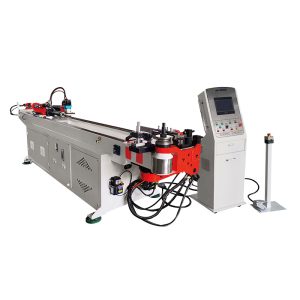
Automatic pipe bending machines are mainly used for pipeline laying and repair in power construction, railway and highway construction, boilers, bridges, and ships. Automatic pipe bending machines are easy to operate, convenient to move, and quick to install, and occupy a dominant position in the pipe bending machine market with wide applications.
What are the technical characteristics of automatic pipe bending machines?
I. Standardized Pipe Shapes in Automatic Pipe Bending Machines
The design and layout of pipes should avoid excessively large arcs, arbitrary curves, compound bends, and arcs greater than 180°. Excessively large arcs not only make the tooling bulky but are also limited by the size of the pipe bending machine. Arbitrary curves and compound bends are poorly designed, greatly hindering mechanized and automated production and making it difficult for operators to avoid heavy manual labor. Arcs greater than 180° make it impossible for the pipe bending machine to unload the mold.
II. Standardized Bending Radius in Automatic Pipe Bending Machines
The bending radius should ideally achieve “one pipe, one mold” and “multiple pipes, one mold.” For a single pipe, regardless of the number of bends or the bending angle, its bending radius can only be one because the bending machine does not change modules during the bending process—this is “one pipe, one mold.” “Multiple pipes, one mold” means that pipes of the same diameter should use the same bending radius as much as possible, that is, using the same set of modules to bend different shapes of pipes, which helps reduce the number of modules required.
III. Appropriate Bending Radius Value
The bending radius of the conduit determines the resistance encountered during bending. Generally, a larger pipe diameter and a smaller bending radius make it prone to internal wrinkling and slippage during bending, making it difficult to guarantee bending quality. Therefore, it is generally advisable to select a bending die R value of 23 times the pipe diameter.
IV. Moderate Bending Speed
The main impact of bending speed on forming quality is as follows: too high a speed can easily cause the bent portion of the conduit to flatten, failing to meet roundness requirements, leading to tearing or breakage; too low a speed can easily cause wrinkling and slippage of the clamping block, and large-diameter pipes are prone to sagging in the bent portion. Based on extensive testing on these two automatic pipe bending machines, the bending speed of the conduit is determined to be 20%-40% of the machine’s maximum bending speed.
Having understood the technical characteristics of the automatic pipe bending machine, if you have specific model requirements or special product needs, please feel free to contact us. Our professional sales staff will be happy to answer your questions and provide the most suitable pipe bending machine for your needs.
Learn More:
Factors affecting bending during CNC pipe bending machine processing
Fully automatic pipe bending machine – handles both square and round pipe processing
Our equipment has CE, ISO quality inspection certificate, so the quality is guaranteed to be cost-effective. According to different processing requirements, machines can be customized to fit for your usage, to provide customized services. In the processing period, we strictly control the production process, to ensure the quality of clearance, standardize the process, strict implementation.

