One-stop Bending Solutions For Wires, Tubes And Pipes
One-stop Bending Solutions For Wires, Tubes And Pipes
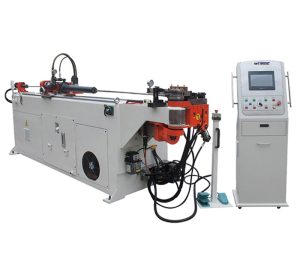
I. Detailed Description of Potential Hazardous Areas of Automatic Pipe Bending Machines
The hazardous areas of automatic pipe bending machines are mainly concentrated in moving parts and operational interaction areas. The risk points and warning requirements for each area are as follows:
1. Total Travel Range of the Bending Arm: This is the most dangerous core area of the entire machine, covering the entire movement trajectory of the bending arm. Especially at the junction of the bending arm and the fixed arm, and at the extreme positions of the bending arm’s reciprocating motion, there is a high risk of crushing and shearing. When the machine is running, this area forms a dynamic hazardous space; any limb or foreign object entering may be instantly clamped or crushed, causing serious injury. This area is marked with prominent red warning signs and the words “No Entry.” Operators must maintain a safe distance at all times and are strictly prohibited from touching or probing this area while the machine is running.
2. Die Movement Range: As a key component in pipe bending, the die’s opening, closing, rotation, and positioning movements can generate risks of pinching and crushing. The mating surfaces, edges, and connecting parts of the mold are all potential danger points. Improper placement of pipe fittings, insecure mold installation, or loosening or displacement of the mold during operation can not only lead to pipe deformation and scrapping, but also accidental mold detachment, resulting in injuries to operators’ hands. This area is marked with a yellow warning sign, reminding operators that before installing, disassembling, or adjusting parameters, the power must be disconnected and the mold must be completely stationary before proceeding.
3. Bending Angle Selector Area: The bending angle selector is usually connected to the machine’s transmission system. Its adjustment knob, connecting rod, and internal gear structure are in a dynamic state during operation. Improper adjustment of the angle selector during machine operation may cause transmission system jamming, sudden angle changes, leading to deviations in bending accuracy or sudden machine stoppage, and even damage to components and personal injury. This area is marked with a “Do Not Adjust During Operation” warning sign. Operators must set the angle according to the operating procedures after the machine has been stopped and the power disconnected. 4. Pipe Loading/Unloading and Rotation Space in Front of the Machine Head: This area involves the most frequent interaction between operators and the machine. When loading or unloading pipes, operators must be close to the machine head. During pipe bending, the pipes rotate around the machine head, posing a risk of collision and entanglement. If the machine head is not completely stationary during loading or unloading, or if hands are not promptly removed from the rotation area, operators may be struck or scratched by moving pipes, or have clothing or limbs entangled in rotating pipes. This area is marked with an orange warning sign, clearly defining the safety boundary for loading and unloading operations. Operators must work within this boundary and immediately evacuate to a safe area after loading or unloading before starting the machine.
All warning signs for hazardous areas follow uniform safety standards. Specific locations and meanings are detailed in the diagrams of the equipment manual. Operators must carefully read the manual before starting work and familiarize themselves with the location and risk points of each hazardous area.

II. Operating Specifications and Requirements for Automatic Pipe Bending Machines
The correct use of automatic pipe bending machines is crucial to ensuring personnel safety and extending the lifespan of the equipment. The following specifications must be strictly followed:
1. Basic Operating Principles and Safety Protection: Operators and mold installers must prioritize safety and adhere to standardized operating procedures, placing their own safety on an equal footing with equipment maintenance. Proper use and regular maintenance not only extend equipment lifespan and reduce failure rates but also minimize safety hazards. Conversely, improper operation and reckless handling can lead to accidents, accelerate wear and tear on machine parts, aging of the transmission system, and control system malfunctions. Even unintentional operational errors can cause irreversible equipment damage.
The safety guard plate next to the bending arm is a core safety protection device. It features a built-in infrared or pressure sensor system. When a worker’s limb, tool, or other foreign object enters the bending arm’s operating range, the system triggers an emergency stop mechanism within milliseconds. The bending arm immediately ceases all movement, and the operating screen displays a red alarm code and a “Danger Area Intrusion” warning, effectively preventing serious injuries. 1. Operators must check the sensitivity of the safety guard plate daily before starting the machine, ensuring it is undamaged and unobstructed. If a malfunction is found, the machine must be stopped immediately and repairs reported. Removing or shielding the safety guard plate while operating the machine is strictly prohibited.
2. Emergency Stop Procedure: The emergency stop button is a crucial device for handling sudden hazards. It is located in a prominent position on the control panel, featuring a red mushroom-shaped design for easy identification and pressing. In emergencies such as material jamming, loose parts, or personnel accidentally entering a dangerous area, the operator must press the emergency stop button immediately. This will instantly cut off power to all motors and servo systems, braking all moving parts.
After the danger has passed, the machine must be restarted according to the following procedure: First, check that the power switch is in the off position. After confirming there are no safety hazards around the equipment and that all parts have returned to their normal positions, turn on the power switch. Only after the machine completes its self-test and the screen displays the normal operating interface can operation continue. Forcibly restarting the machine before the danger has passed or the equipment has completed its self-test is strictly prohibited.
3. Load Control and Equipment Protection: Avoiding machine overload is crucial for extending equipment life and ensuring operational safety. Overload usually stems from the bending torque required for pipe fittings exceeding the machine’s design specifications. This often occurs because operators fail to accurately determine the pipe fitting material and specifications, or blindly pursue production efficiency by improperly setting bending parameters. Overload can cause equipment malfunctions such as bending arm deformation, mold damage, and wear on transmission gears. It can also lead to safety accidents due to component breakage and pipe ejection.
III. Safety Training
Professional pre-job training and assessment can prevent or minimize potential accidents during production. Safety training programs must be supervised and guided by leaders and managers. Managers must maintain a high level of awareness of safe operations throughout all their job responsibilities. Appropriate training is necessary to achieve maximum protection. Employees should be regularly instilled with safety awareness regarding the work environment and machine operation, and key rules such as mold installation instructions, safety devices and operating methods, and personal safety should be emphasized to their individual safety consciousness.
Our company website features many different models of machines, each with different uses. Please feel free to contact us anytime if you have any needs. We have professional sales staff ready to answer your questions.
Learn More:
Precautions for operating automatic wire bending machine
A Comprehensive Guide to Buying a Tube Bending CNC Pipe Bending Machine
Our equipment has CE, ISO quality inspection certificate, so the quality is guaranteed to be cost-effective. According to different processing requirements, machines can be customized to fit for your usage, to provide customized services. In the processing period, we strictly control the production process, to ensure the quality of clearance, standardize the process, strict implementation.

